Why Seven Vegetables?
The number seven recurs through Moroccan culinary tradition — Friday couscous with seven vegetables, celebration tagines with seven vegetables — not as a rigid rule but as a guiding principle that points toward abundance and balance. The point of seven is variety: something dense and sweet like carrots, something delicate like courgette, something earthy like potato, the brightness of tomato and pepper. Together they create a complete palette of textures and flavours in a single pot.
What sets a Moroccan vegetable tagine apart from any other braised-vegetable dish is chermoula — a deeply aromatic blend of coriander, parsley, garlic, olive oil, cumin, and paprika that functions both as a marinade and as a layer sauce. It is the element that turns a collection of vegetables into something unmistakably Moroccan.
Make the Chermoula First
Do not start cutting vegetables until the chermoula is ready. In a blender or by hand: a generous handful each of fresh coriander and flat-leaf parsley, three garlic cloves, four tablespoons of olive oil, one teaspoon each of cumin and sweet paprika, salt and black pepper. Blend to a smooth green sauce, or leave it slightly coarse if you prefer texture. Divide into two portions — half for marinating the vegetables, half to spread between the layers in the tagine.
Can Chermoula Be Made Ahead?
Yes, and it is more fragrant after a night in the fridge. It keeps for a week in an airtight jar with a thin layer of olive oil over the surface.
The Seven Classic Vegetables
- 2 carrots — peeled, halved lengthways
- 2 courgettes — quartered lengthways
- 2 medium potatoes — peeled, cut into thick rounds
- 1 large red pepper — sliced
- 1 green pepper — sliced
- 2 medium tomatoes — sliced into rounds
- 2 onions — sliced into rings
In season, turnip, squash, artichoke hearts, or pre-cooked chickpeas are welcome additions. There is no fixed list — the principle is variety in density, texture, and cooking time.
The Layering Order — This Is the Technique
Stacking order matters significantly because the heat at the base of the tagine is far more intense than the gentle steam reaching the top layers:
- Bottom layer: Onion rings — they caramelise slowly and form the flavour base.
- Second layer: Potato rounds and carrots — the densest vegetables that need the longest cooking time.
- Third layer: Courgette and peppers.
- Top layer: Tomato rounds — they cook through with steam alone and release their moisture down through all the layers.
Between each layer: a generous spoonful of chermoula. Pour the saffron water, remaining water, and olive oil in from the sides of the tagine — not from above, which would wash the chermoula off the top layer.
Slow Cooking — Leave the Lid Alone
Cover the tagine tightly and set the heat to its absolute minimum. The sealed tagine works like a small pressure vessel: internal steam cooks the upper layers while direct heat works through the bottom. Open it once at the 30-minute mark to check the liquid level only — add a quarter cup of warm water if it looks dry. After 60 minutes, test the potatoes with a thin knife. If it enters without resistance, the tagine is ready. If not, give it another 15 minutes.
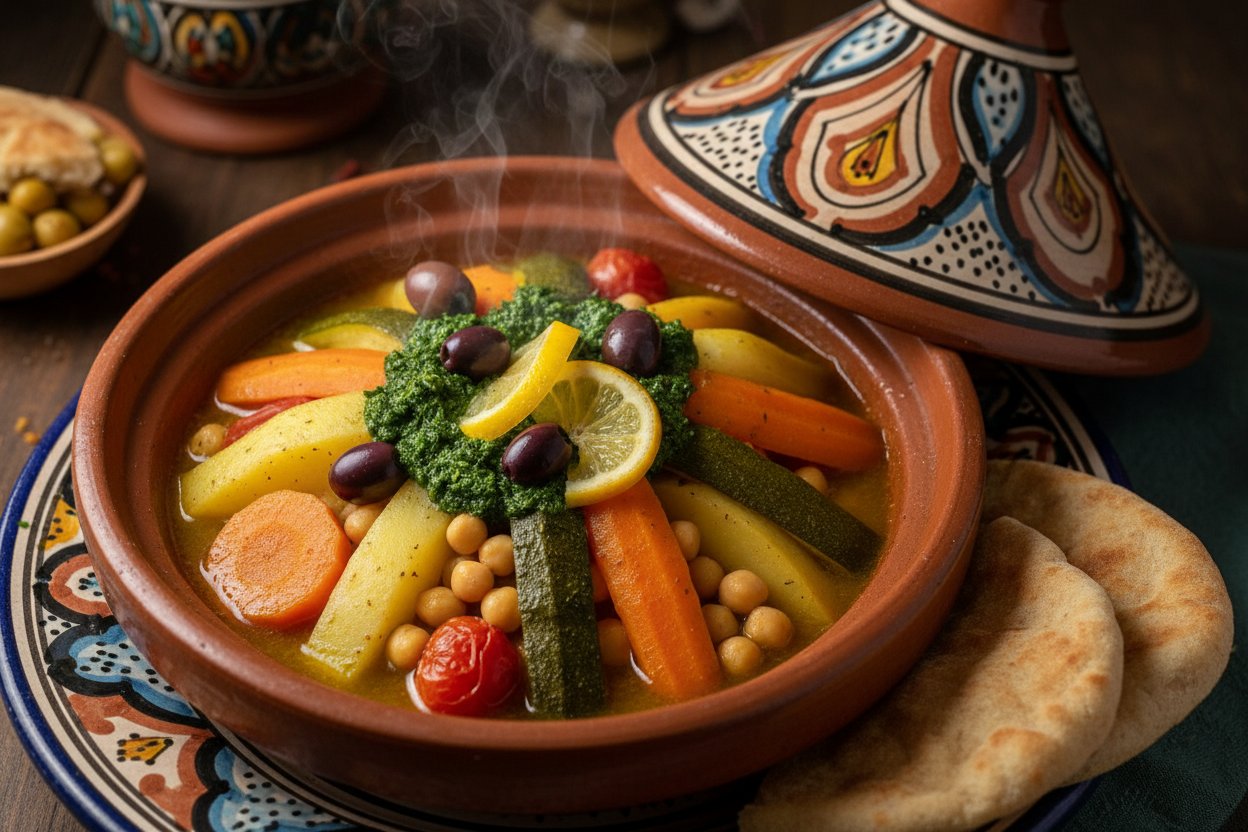
Do not stir or rearrange the layers — the visual effect of intact, graduated layers of colourful vegetables is part of what makes this dish feel like an occasion.
Serving
Bring the tagine to the table with the lid on. Fresh parsley and a drizzle of extra-virgin olive oil over the top before serving. Moroccan flatbread is the traditional accompaniment for mopping up the vegetable broth. On a Friday or for a larger group, serve alongside a mound of steamed couscous.
Frequently Asked Questions
What are the seven classic vegetables in Moroccan tagine?
Carrot, courgette, potato, red pepper, green pepper, tomato, and onion form the most common combination. Turnip, squash, artichoke, and pre-cooked chickpeas appear seasonally. There is no single fixed list — variety in texture and cooking time is the guiding principle.
Why does the layering order matter?
Dense, slow-cooking vegetables (potato, carrot) go at the bottom where heat is strongest. Delicate, quick-cooking ones (tomato, pepper) go on top where gentle steam is sufficient. Reversing the order gives you unevenly cooked vegetables.
What is chermoula and is it essential?
Chermoula is a Moroccan herb marinade — coriander, parsley, garlic, olive oil, cumin, and paprika. It is the defining flavour element of this tagine. You can adjust the spice proportions, but leaving it out entirely produces a very different dish.
Bread or couscous alongside?
Moroccan flatbread (khobz) for everyday serving. Steamed couscous for Friday family lunches or larger gatherings. Both are traditional.
Can I add chickpeas to a vegetable tagine?
Yes — pre-cooked chickpeas are a classic addition that adds protein and absorbs the braising juices beautifully. Place them in the potato layer at the base of the tagine.
Ingredients
- 3 carrots, peeled and cut in half lengthwise
- 2 zucchini (Italian squash), cut into quarters
- 2 medium potatoes, peeled and cut into thick slices
- 1 large red pepper, sliced
- 1 green pepper, sliced
- 2 medium tomatoes, cut into rings
- 2 medium onions, cut into rings
- a handful of chermoula (parsley + cilantro + garlic + olive oil + cumin + sweet paprika + salt)
- 1/4 teaspoon saffron in 3 tablespoons warm water
- 3 tablespoons olive oil
- half a cup of water
- salt and black pepper
How to make it
Prepare the chermoula
Blend in the blender: a handful of fresh cilantro, a handful of parsley, 3 cloves of garlic, 4 tablespoons olive oil, 1 tablespoon cumin, 1 tablespoon sweet paprika, salt and pepper. Grind until it becomes a smooth green sauce. Use half the amount for marinating and half for drizzling.
Marinate the vegetables
Toss the cut vegetables with half the chermoula until well coated. They can be left for an hour in the refrigerator to deepen the flavor.
Layer in the tagine
At the bottom of the tagine: onion first. Above it: the potatoes and carrots (the densest). Then: the zucchini and peppers. On top: the tomatoes. Between each layer: sprinkle the chermoula. Pour the saffron water, the water, and the olive oil down the sides.
Slow cooking
Cover the tagine and set the heat to its lowest setting. Cook for 60-75 minutes until the potatoes and carrots are fully cooked. Check halfway through and add a quarter cup of water if the liquid runs dry.
Frequently Asked Questions
What are the classic seven vegetables in a Moroccan tagine?
Carrot, zucchini, potato, red and green pepper, tomato, onion. Add according to the season: turnip, pumpkin, artichoke, or chickpeas.
Why are the vegetables arranged in a particular order in the tagine?
The dense, slow-cooking ones (potato, carrot) go at the bottom where the heat is highest. The thin, fast-cooking ones (tomato, pepper) go on top where the steam cooks them gently.
What is chermoula, and can it be substituted?
A blend of cilantro, parsley, garlic, olive oil, and spices - the heart of the tagine's flavor. Replacing it is not advisable, but the spice ratios can be adjusted.
What is the vegetable tagine served with?
Fresh Moroccan bread for dipping, or over steamed couscous in large family meals.
Can chickpeas be added to the vegetable tagine?
Yes. Pre-boiled chickpeas are a classic addition - they soak up the broth and add protein. Add them with the layer of potatoes at the bottom.
Rate this article
Tap a star