The Pot Is the Recipe
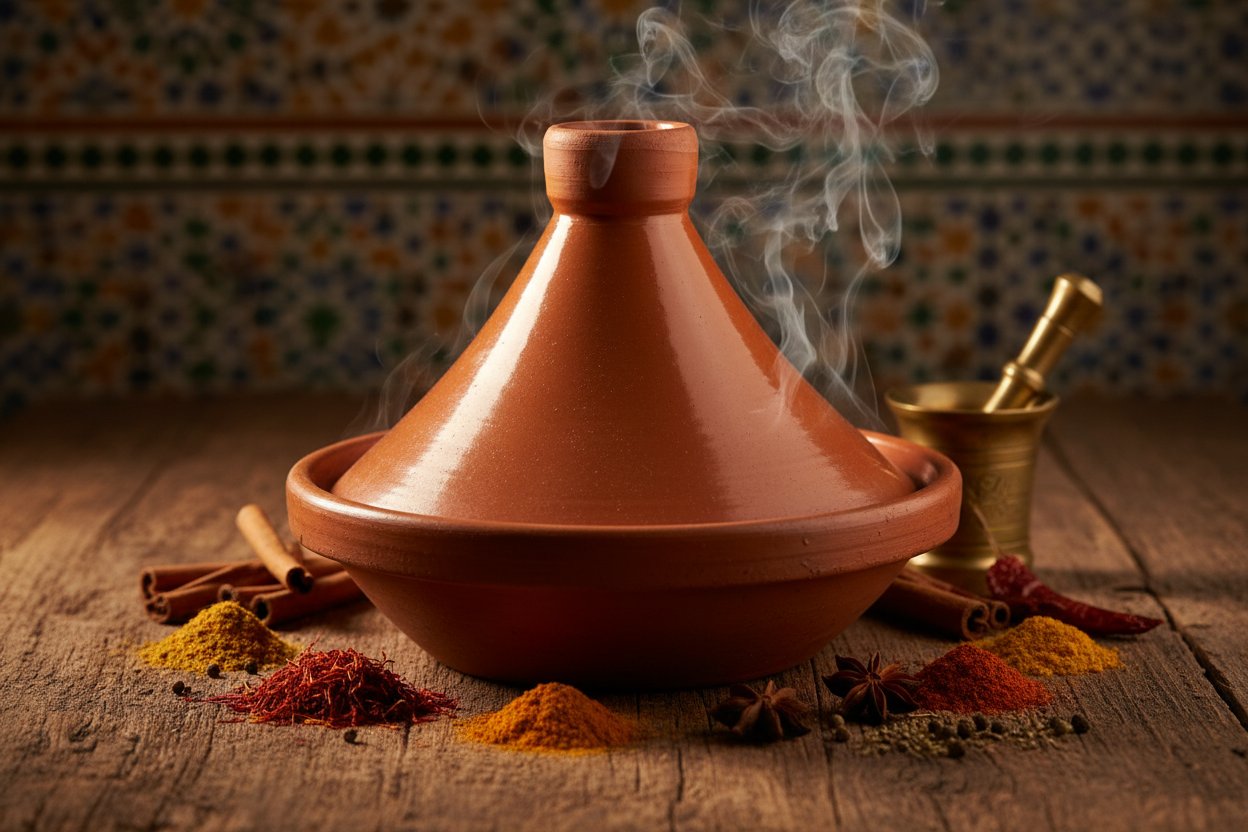
Moroccan cooks say the tagine teaches patience, and they mean it literally. The conical lid is not decorative — it is a moisture-management device. As steam rises from the simmering ingredients, it hits the cooler cone, condenses, and runs back down to the base in a continuous cycle. Very little moisture escapes. That is why a tagine needs far less added liquid than a regular pot to produce a richly sauced result.
The clay itself adds something more. Unlike steel or aluminium, unglazed terracotta is slightly porous — it allows a trace of moisture to evaporate through the walls, which cools the exterior and stabilises the internal temperature at a lower, more even level. This is the reason tagine-braised meat is consistently more tender than the same cut cooked in a pressure cooker or a cast-iron pan, even at the same nominal duration.
Seasoning a New Clay Tagine — Do Not Skip This
A new clay tagine needs to be seasoned before its first use with food. This process seals the larger surface pores, reinforces the structure, and eliminates the raw-earth taste that can transfer to early batches of food. It is not tradition for tradition's sake — untreated clay is structurally weaker and more prone to cracking.
- Soaking: Submerge both base and lid in cold water and leave for two hours. You will see small bubbles rising — the clay is absorbing water, which is exactly what you want.
- Oiling: Remove from the water and blot gently without fully drying. Rub the inside surface of the base generously with olive oil.
- Gradual heating: Place the tagine in a completely cold oven (do not preheat). Set the temperature to 150°C and leave for one full hour. Turn the oven off and let the tagine cool inside it — do not remove it while hot.
After this process, your tagine is ready and should last for years with proper care.
Low Heat — The Physics Behind the Rule
Clay has a much lower thermal expansion coefficient than steel. This means it needs significantly more time to absorb and distribute heat evenly. When you place a cold tagine on a high flame, the bottom section in direct contact with the heat expands rapidly while the upper sections remain cool. This differential expansion creates internal stress — and stress in clay means cracks.
Low heat allows the entire vessel to warm gradually and uniformly, eliminating that differential. It is also, incidentally, the best cooking method for the contents: collagen in meat breaks down at sustained low temperatures, producing the characteristic tenderness of a properly made tagine.
Do You Need a Heat Diffuser?
On a domestic gas hob, the flame concentrates heat at a single central point. A heat diffuser — a thin metal disc placed between the tagine base and the burner — spreads that heat across the full diameter of the base. On a wood fire or charcoal, the heat is already naturally distributed. If you cook on gas, a diffuser is worth having.
Mistakes That Crack a Clay Tagine
- Thermal shock: Placing a cold tagine on an already-hot burner, or pouring cold liquid into a hot tagine. This is the most common cause of cracks.
- Drying in a hot oven after washing: Some people put a wet tagine directly into a hot oven to speed drying — the rapid heat change stresses the clay.
- Cooking with too little liquid: Dry-cooking in a clay tagine overworks the material and accelerates cracking. Always ensure there is some moisture at the start.
- Using harsh soap: Soap penetrates the pores of unglazed clay and transfers taste to the next batch of food. Warm water and a soft sponge are enough.
Cleaning and Storing the Tagine
The rule that overrides everything: let the tagine cool completely to room temperature before exposing it to water. A hot tagine hit with cold water suffers thermal shock from the other direction. Wash by hand with warm water only. No dishwasher, no abrasive pads, no soap. Dry with a soft cloth, then air-dry fully before storing.
For storage: place a sheet of kitchen paper between the base and the lid to allow airflow and prevent moisture trapping. A tagine needs to breathe in storage, just as it does in use.
Clay Versus Enamelled Iron or Glass — Is There a Real Difference?
Both enamelled cast iron and oven-safe glass produce good results, and both are easier to maintain. But neither replicates what unglazed clay does. Cast iron distributes heat efficiently and tolerates direct flame, but it does not breathe. Glass is suitable for the oven but cannot go on direct heat at all. If the flavour of an authentic Moroccan tagine is the goal, terracotta clay has no equivalent.
Frequently Asked Questions
How do I season a new clay tagine before using it?
Soak base and lid in cold water for two hours. Rub the inside of the base with olive oil. Place in a cold oven, heat to 150°C, leave for one hour, then turn off the oven and let it cool inside. Do not rush this process.
Why is low heat essential for a clay tagine?
Clay expands slowly — high heat warms the base rapidly while the upper sections stay cool, creating differential expansion that cracks the pot. Low heat allows the entire vessel to warm evenly.
Can I use a clay tagine on a gas hob?
Yes, if it has been properly seasoned. Use a heat diffuser between the base and the burner to distribute the flame. Never place a cold tagine on an already-lit burner.
How do I clean a clay tagine?
Wait until it is completely cool. Hand-wash with warm water and a soft sponge — no soap (it absorbs into the pores), no dishwasher. Air-dry fully before storing, with the lid slightly ajar.
Does a clay tagine really taste different from a regular pot?
Yes, in a measurable way. The porous clay stabilises cooking temperature at a lower, steadier level than steel. The result is more tender meat and a more concentrated sauce that a steel pot cannot easily replicate.
Frequently Asked Questions
How do I prepare a new earthenware tagine before its first use?
Soak it for two hours in cold water, brush it with olive oil, place it in a cold oven and gradually raise the heat to 150 degrees, keep it there for an hour, then turn off the oven and let it cool down with it.
Why is gentle heat necessary with earthenware?
Earthenware expands slowly. High heat warms the lower part quickly while keeping the top cold - so the pot cracks. Gentle heat allows even heat absorption.
Is an earthenware tagine suitable for direct gas?
Yes, if it is seasoned and treated. Use a heat diffuser between it and the flame. Do not place it cold onto a lit flame.
How do I clean an earthenware tagine?
Let it cool completely. Wash it by hand with warm water and no soap (it soaks into the pores). No dishwasher. Dry it and store it uncovered so it can breathe.
What is the difference in taste between an earthenware tagine and an ordinary pot?
The pores of the clay slow evaporation and hold the temperature lower than a steel pot would. The result is more tender meat and a more concentrated, deeper sauce.
Rate this article
Tap a star