Mistake 1 — Hot Syrup on Hot Baklava
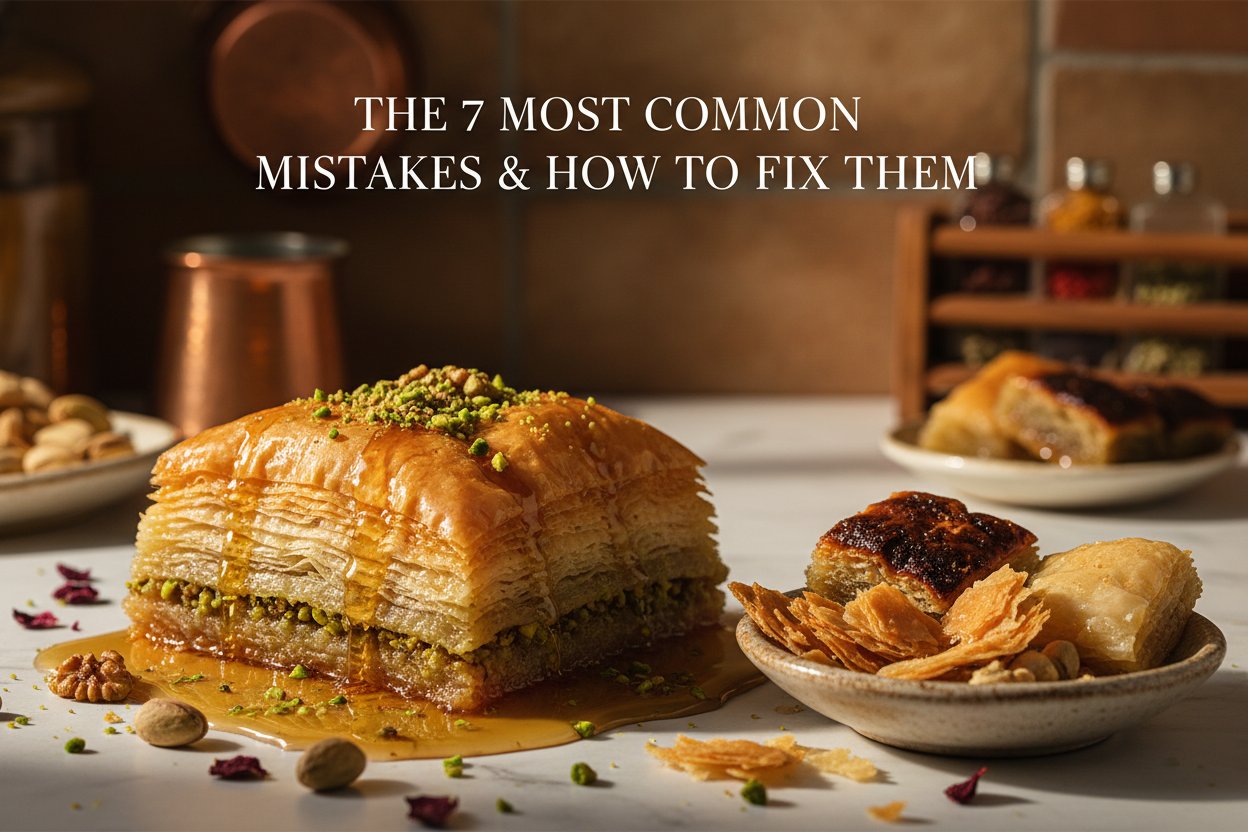
This is the most common and most damaging mistake. When hot syrup meets hot baklava, the thermal overlap saturates the pastry until it becomes sponge-like and heavy. The golden rule with no exceptions: cool syrup (at room temperature) poured over hot baklava the moment it comes out of the oven. Or the reverse: hot syrup over completely cold baklava. The temperature difference between the two is the mechanism — not a preference.
Mistake 2 — Cutting After Baking
Many beginners bake the baklava whole and then try to cut it after it has crisped. The result: layers that shatter and crumble, uneven pieces, and a ruined presentation. The fix: cut with a long, sharp knife before the tray enters the oven. Press firmly straight down without dragging the blade.
Mistake 3 — Dry, Cracked Phyllo
Phyllo dries in the open air within minutes. If some sheets dry and crack before you layer them, those layers will not bond and the baklava will fall apart when cut. Fix: keep all unused phyllo sheets covered with a barely damp (not wet) cloth throughout the entire layering process.
Mistake 4 — Under-Buttering the Layers
Skimping on butter means uneven browning and dry, dull-looking phyllo. Every sheet needs a thin, even coat of butter from edge to edge. The first and last sheets need slightly more than the rest.
Mistake 5 — Wrong Oven Temperature
Too low (below 170°C): the phyllo dries instead of browning. Too high (above 190°C): the edges burn before the centre cooks. The optimal range is 175-180°C. Always use the middle rack.
Mistake 6 — Syrup That Is Too Thin or Too Thick
Watery syrup makes the baklava soggy even if poured correctly. Syrup as thick as heavy honey sits on the surface and never penetrates. Test: a drop on a cold plate should spread slowly into a thin puddle. Return to the boil for two minutes if too thin; add a tablespoon of water and reboil if too thick.
Mistake 7 — Filling Ground Too Fine
Walnuts or pistachios blitzed to a powder give a paste, not a filling. When you eat it you feel no texture contrast. Grind coarsely — small, irregular pieces. Use the pulse setting on a food processor, not continuous blending.
Frequently Asked Questions
My baklava coloured unevenly — can I fix it in the oven?
Rotate the tray 180 degrees at the halfway point of baking. If the edges burn before the centre is done, lay a loose piece of foil over the corners and let the centre finish.
I forgot to pour the syrup and the baklava is now completely cold — what do I do?
Bring the syrup to a boil and pour it hot over the cold baklava. This is the acceptable second option (hot over cold). It will not be as perfect as cool-over-hot, but it will be good.
The baklava looks fine but the syrup has not absorbed — why?
Either the syrup was too thick, or the baklava was not hot enough when you poured. Cool syrup only absorbs into hot baklava.
Can soggy baklava be rescued?
With difficulty. Return it to a 150°C oven for 15 minutes to evaporate some moisture. It will not be as good as it should have been, but it will improve. Prevention: less syrup, and always cool syrup on hot baklava.
Frequently Asked Questions
Why is my baklava soggy and heavy?
You poured hot syrup over hot baklava. The rule: cold syrup on hot baklava only.
Why didn't the phyllo turn golden evenly?
The ghee was not distributed evenly, or the oven is uneven. Rotate the tray 180 degrees halfway through the time.
Why do my pieces crumble?
You cut after baking. Always cut before the oven with a sharp knife.
Why did the edges burn?
Cover the edges with loose aluminum foil halfway through baking. Always use the middle rack.
Rate this article
Tap a star